Coming soon
The intelligence layer between AI and the 3D world.
Chewi compiles semantic structure onto 3D assets so AI models can understand, reason about and interact with them.
Curious? Get in touch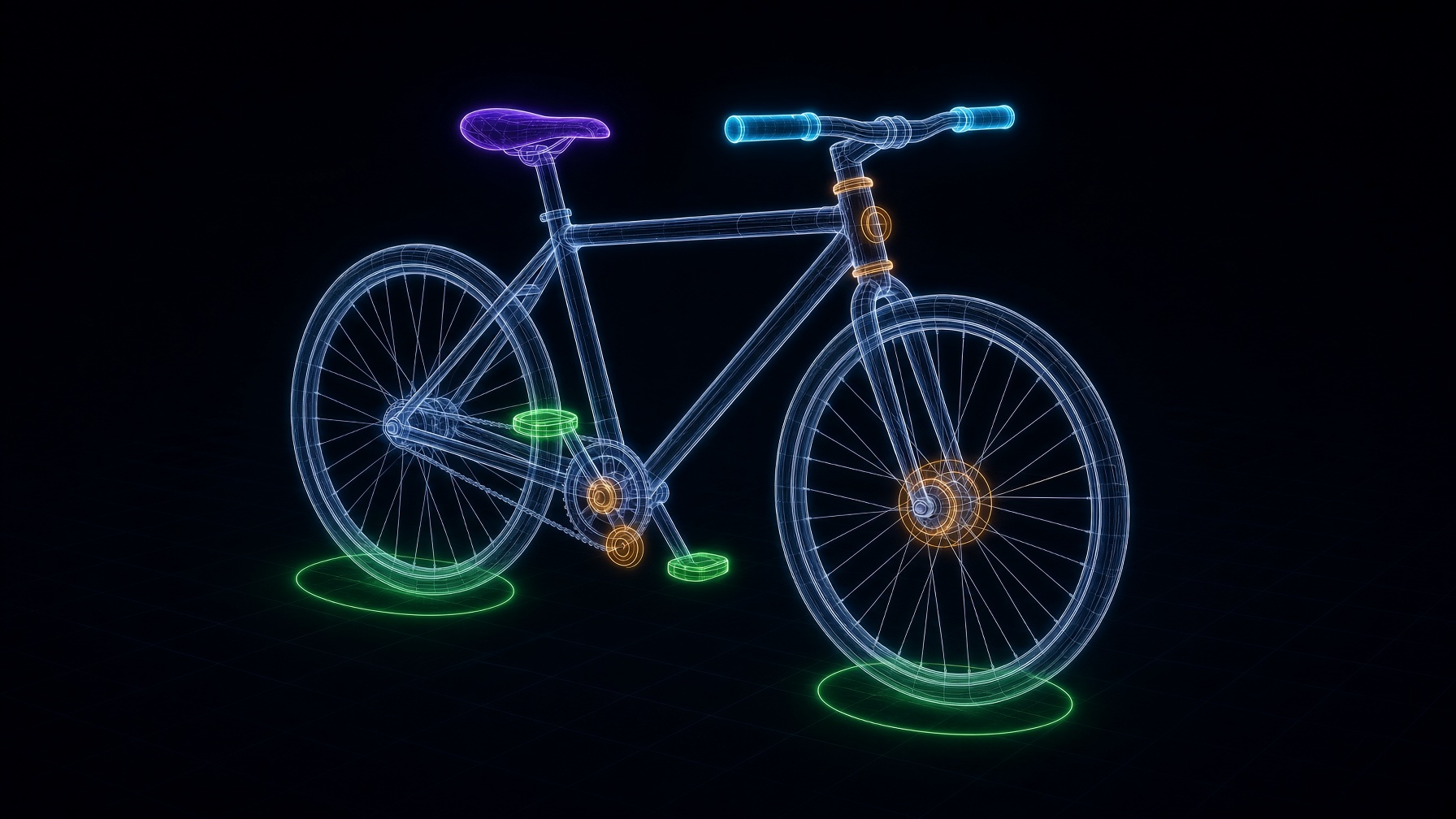
What a compiled asset carries
Every surface Chewi compiles travels with the asset as machine-readable data: what it is, what it is for, and which joint it is rigidly attached to. This is the manifest of the bicycle at the top of the page, 10 action surfaces.
Illustrative manifest for the demo asset above; joint identifiers follow the demo rig's naming. Production manifests also bind each surface to geometry and carry constraints, confidence and provenance.
| id | kind | role | attached_to |
|---|
What Chewi sees
A rider mounting and pedalling. The highlighted regions are compiled action surfaces: the seat, foot and grip contacts that keep the rider attached to the bicycle through the whole motion.
Real pipeline output, not a render.
Joint endpoints versus compiled surfaces, same rider, same bicycle
| Contact | Before | With compiled surfaces |
|---|---|---|
| Grips, target error | 172 mm | 0.02 mm |
| Pedals, positional error | 7.6 to 9.5 mm | 0.01 mm |
| Pedals, sole-angle mismatch | 67.4° (left) | 0.06° left, right within 1.28° |
| Seat, pelvis to seat error | 14.4 mm | 0.018 mm |
| Tires, gap to ground | 9.0 mm rear, 14.6 mm front | none, 2.1 to 2.3 mm grounding overlap |
| Wheel radius | 5.92 mm short | compiled radius drives spin and drivetrain phase |
Measured on the team's V5.1 validation of this asset pair. Before: targets on the ends of the joint chains. After: targets on the compiled action surfaces.
AI understands the world. 3D data doesn't speak its language.
Foundation models increasingly understand objects, behaviours and relationships in the physical world. Existing 3D data is inconsistent, or structured for human production workflows rather than for AI reasoning. Chewi closes that gap.
- 3D assetGeometry and structure, as it exists in the library today.
- ChewiA semantic correspondence layer, compiled automatically and validated.
- AI / world modelUnderstands, reasons about and interacts with the object.
From geometry to machine-understandable structure
Chewi enriches assets with structured information about components, relationships, articulation, physical properties and possible interactions, so AI models can apply what they already know about the world directly to 3D data.
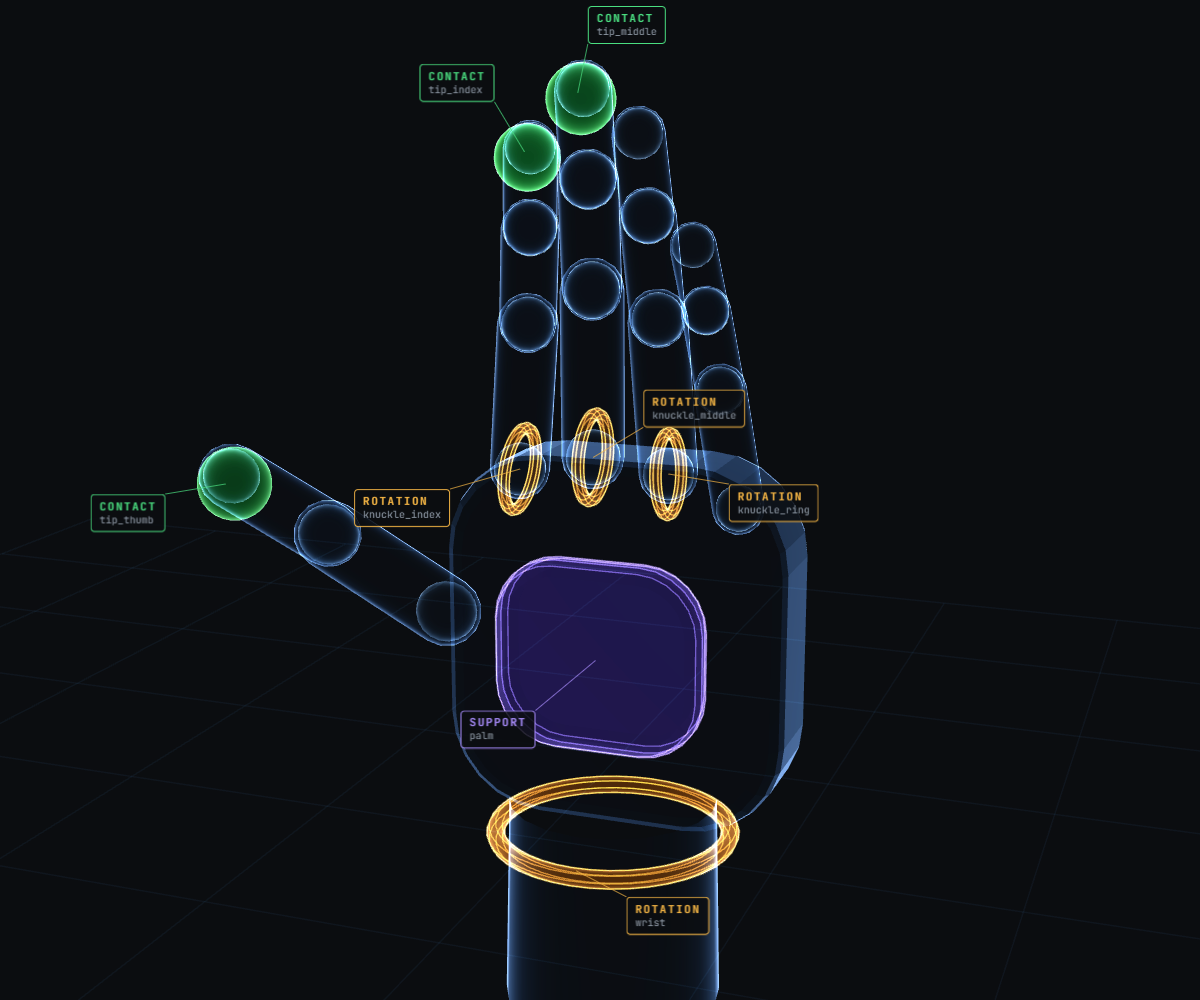
A hand opening from a fist: contact pads on the fingertips, rotation axes at the knuckles and wrist, the palm as a support surface. Live, drag to orbit.
Components & relationships
What the elements are and how they relate to each other.
Articulation & structure
Joints, hierarchies, axes and movable parts.
Physical & functional properties
Structured properties for reasoning about behaviour.
Interaction & affordances
How objects and their parts can be manipulated.
Machine-readable semantics
Structured information that travels with the asset.
Built for world models, robotics, industrial simulation and spatial computing.
Where this matters
World models & spatial AI
Representations for models that reason about the physical world.
Robotics & physical AI
Structured 3D data for simulation, training and interaction.
Industrial simulation & digital twins
Higher-precision semantic and physical representations.
Spatial computing & AI glasses
Machine understanding of objects, components and relationships.
Built for 3D data at scale
Chewi is being developed to automate semantic structuring across large, heterogeneous asset libraries, reducing manual preparation for AI, simulation and world-model applications. As the library grows, each accepted asset becomes a better prior for the next.
Precision matched to the application
Different applications need different levels of semantic and physical precision. Chewi is designed for high-volume automation through higher-assurance workflows, with tighter validation, confidence scores and expert review where the application demands it.
Two standards, kept separate
An asset that artists and agents can edit is not automatically one that can take part in a shared simulation. We think of them as two bars, each with its own evidence.
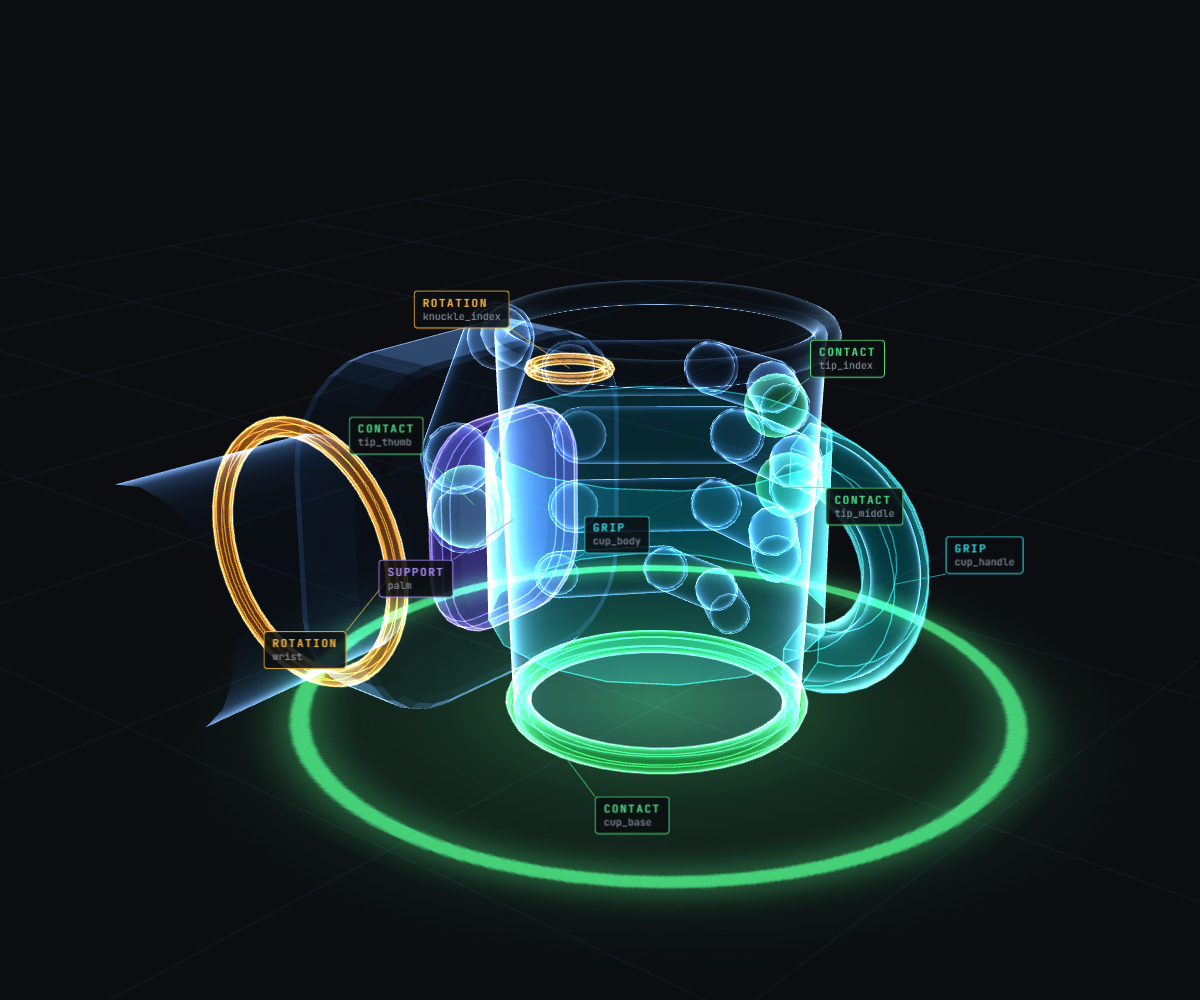
A hand and a cup, each a usable asset on its own. The grasp only works when their contact surfaces, scale and articulation agree. Live, drag to orbit.
Production editability
Can humans and AI agents modify the asset reliably?
- Meaning identifiable parts, landmarks, joints and material regions.
- Correspondence stable references across revisions, even when topology changes.
- Constraints protected features, attachments, symmetry, permitted deformation.
- Review and recovery recorded changes, validation results, reversible versions.
Shared-world interaction
Can the asset interact consistently with other participants under the same rules?
- Conventions common units and coordinate frames.
- Physics collision geometry, physical properties, joint limits.
- Actions interaction points, supported actions, rules for changing state.
- Evidence from contact, loading and articulation over time, not from a rendering check.